

Peptide injections are best understood as a delivery method used in scientific research and regulated medicine, rather than as a consumer practice. Peptides themselves are short chains of amino acids that act as signalling molecules, influencing hormones, metabolism, immune responses, and tissue repair. Because many peptides are unstable in the digestive tract and poorly absorbed when taken orally, injection-based delivery has become the dominant route for studying their effects in controlled experimental settings. Peptide Injections
In laboratories and drug-development programmes, injectable peptide solutions are used to explore pharmacokinetics (how the body handles a peptide) and pharmacodynamics (what the peptide does in the body). This includes research into endocrine signalling, metabolic regulation, wound healing, immune modulation, and other physiological pathways. Importantly, this work takes place under ethical approval, regulatory oversight, and strict experimental controls—very different from informal or unsupervised use sometimes discussed online.
For a UK audience, it is also critical to separate licensed peptide medicines (such as prescribed insulin or GLP-1 receptor agonists) from unlicensed research peptides. The latter are not approved for human use and should never be promoted as treatments or therapies. Instead, they are tools used by researchers to generate data, test hypotheses, and support early-stage development. Peptide Injections
Within this framework, LabGradePeptides.uk can be positioned as a UK-based supplier of high-purity research peptides. These peptides are provided as raw research reagents—typically in lyophilised form—that laboratories may then formulate into injectable solutions only within approved in-vitro, ex-vivo, or preclinical models. They are not sold for self-administration, medical treatment, or any form of unsupervised “peptide therapy.”
By framing peptide injections in this way, your blog can educate readers on why injections are important in peptide research, while clearly reinforcing that all discussion relates to scientific and regulatory contexts, not consumer use.
Peptide injections refer to solutions containing dissolved peptide molecules that are delivered using a needle and syringe, most commonly via subcutaneous or intramuscular routes in research and clinical-development settings. In scientific literature, this delivery method is discussed because it allows peptides to reach systemic circulation intact and at predictable concentrations, which is difficult to achieve with many oral formulations. Peptide Injections
Peptides are structurally fragile compared with small-molecule drugs. When taken orally, they are typically:
For this reason, injections remain the standard delivery route for many peptide therapeutics and research compounds.
In laboratories, peptide injections are not about treatment but about measurement and understanding. Researchers use injectable formulations to:
These studies underpin much of what is known about peptide-based medicines used today. Peptide Injections
It’s important to clarify that “peptide injections” in a research context are:
For UK-based research teams, suppliers such as LabGradePeptides.uk fit into this ecosystem by providing research-grade peptide materials. These materials are supplied as reagents, not as ready-to-use injectables, and any formulation or administration occurs only within approved research frameworks.
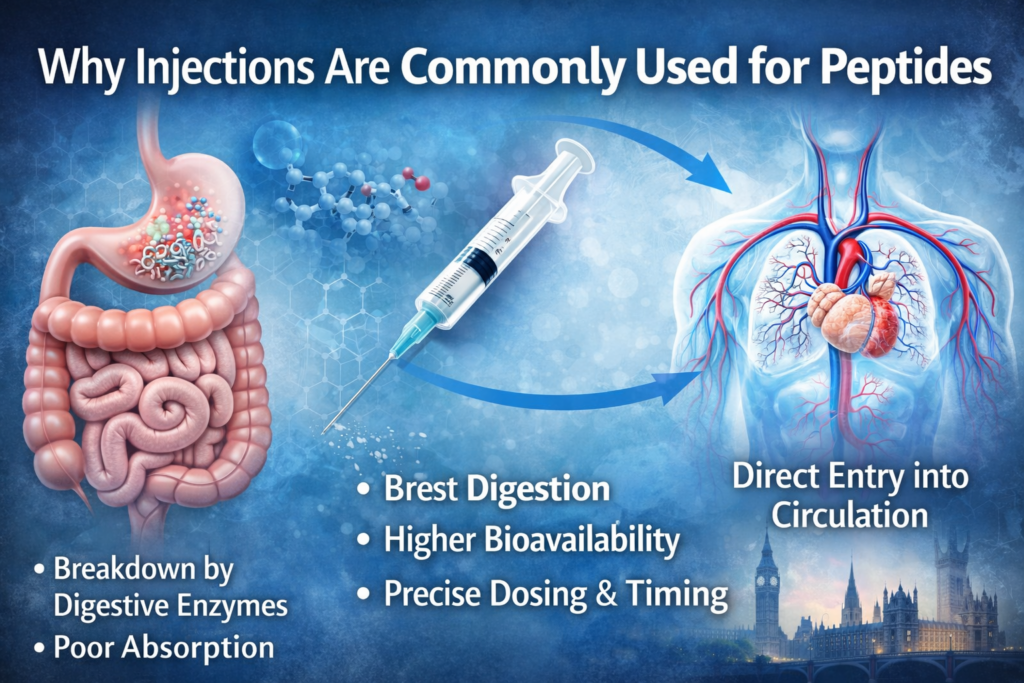
In peptide research and pharmaceutical development, injections are widely used because they offer reliability, control, and predictability that other delivery routes often cannot provide. This is especially important when scientists are studying how peptides interact with receptors, hormones, or specific tissues. Peptide Injections
One of the main reasons injections are favoured is that peptides are highly vulnerable to the digestive system. When taken orally, most peptides are:
Injectable delivery bypasses these barriers entirely, allowing researchers to observe the peptide’s biological effects without confounding variables introduced by digestion.
Injection-based delivery enables a much higher and more consistent proportion of the administered peptide to reach circulation. This predictability is essential in research, where small changes in exposure can significantly affect experimental outcomes. Peptide Injections
Because of this reliability, injectable delivery has underpinned the development of many peptide-based medicines, including incretin mimetics, insulin analogues, and growth hormone–related compounds. The same principles apply in preclinical research, where consistent exposure allows meaningful comparisons between study groups.
Another key advantage of injections is dose accuracy. Researchers can:
This level of control is critical for pharmacokinetic and pharmacodynamic modelling, helping scientists understand how long a peptide remains active, how quickly it reaches peak levels, and how receptors respond over time. Peptide Injections
At the foundation of this process is the quality of the peptide itself. Research suppliers such as LabGradePeptides.uk provide the high-purity peptide material that laboratories rely on before any formulation or injection work begins. Their role is limited to supplying research-grade reagents, leaving all formulation, dosing, and administration decisions to qualified research teams operating under approved protocols.
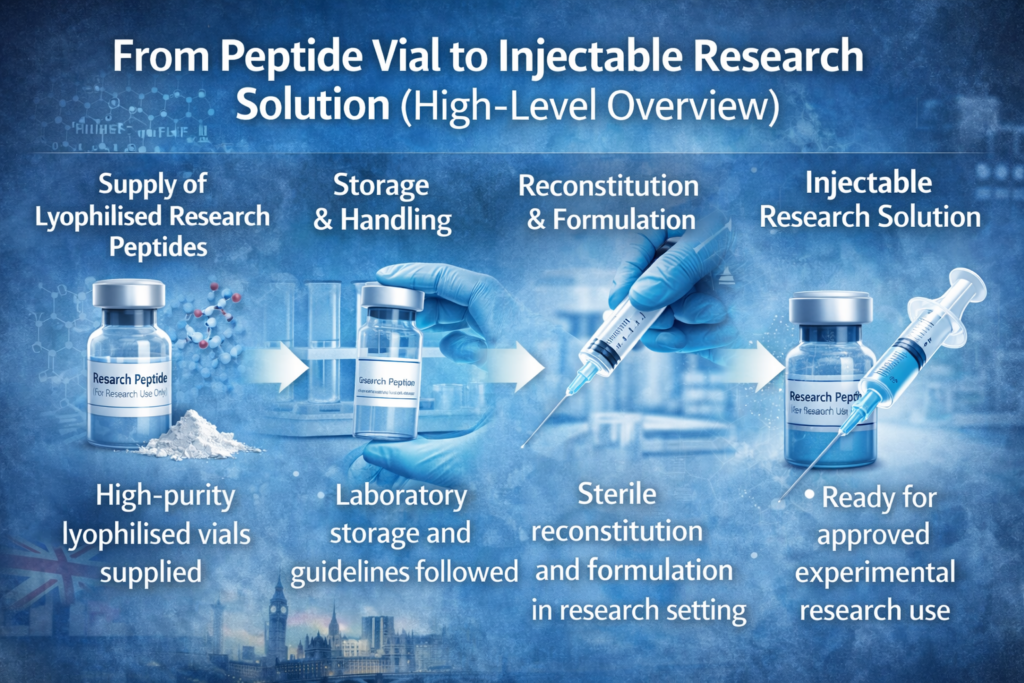
To help readers understand where a supplier fits into the research pipeline—without giving step-by-step instructions—it’s useful to describe the general lifecycle of an injectable peptide in laboratory research. This keeps the article educational, transparent, and compliant. Peptide Injections
Most research peptides are supplied as lyophilised (freeze-dried) powders in sealed vials. This format improves stability during transport and storage and allows researchers to work with precisely defined quantities.
At this stage, suppliers such as LabGradePeptides.uk focus on:
The supplier’s role ends here—providing the raw peptide reagent needed for downstream research.
Once received, peptides are handled according to manufacturer and institutional guidelines. Research literature and supplier guidance consistently emphasise:
These practices help ensure reproducibility and reliable experimental results. Peptide Injections
In qualified research environments, lyophilised peptides may be reconstituted and formulated under sterile, controlled conditions for use in:
In formal drug-development settings, additional formulation work may be carried out to study stability, pH tolerance, or delivery kinetics. Importantly, all of this work is conducted by trained professionals under ethical approval and regulatory oversight.
It’s important to state clearly in your blog that:
This distinction reinforces the research-only positioning and helps readers understand how peptide injections fit into legitimate scientific workflows. Peptide Injections
To give readers practical context, your blog can outline broad categories of peptides that are commonly investigated using injectable delivery in research and drug-development settings. This helps explain why injections are relevant—without promoting or instructing personal use.
Some of the most well-known injectable peptides are involved in glucose regulation, appetite control, and metabolic signalling.
In non-clinical research, laboratories may obtain research-grade analogues of these peptides to study receptor binding, signalling pathways, or pharmacokinetics in controlled models—sourcing the raw peptide material from suppliers like LabGradePeptides.uk. Peptide Injections
Another category frequently delivered via injection in research is growth hormone–related peptides, including:
These peptides act on pituitary or hypothalamic pathways and typically require systemic exposure to exert measurable effects. In research settings, injectable delivery enables:
Your blog can emphasise that such work is conducted in formal research environments, not as bodybuilding or lifestyle interventions. Peptide Injections
Peptides are also widely used in immunology and vaccine research.
These studies are foundational in the development of peptide-based vaccines and immunotherapies.
In oncology and precision medicine research, peptides are sometimes used as targeting ligands or as part of peptide–drug conjugates (PDCs).
Again, this work starts with high-purity research peptides supplied as reagents, rather than finished injectable products. Peptide Injections
By presenting these examples as scientific categories, you help readers understand:
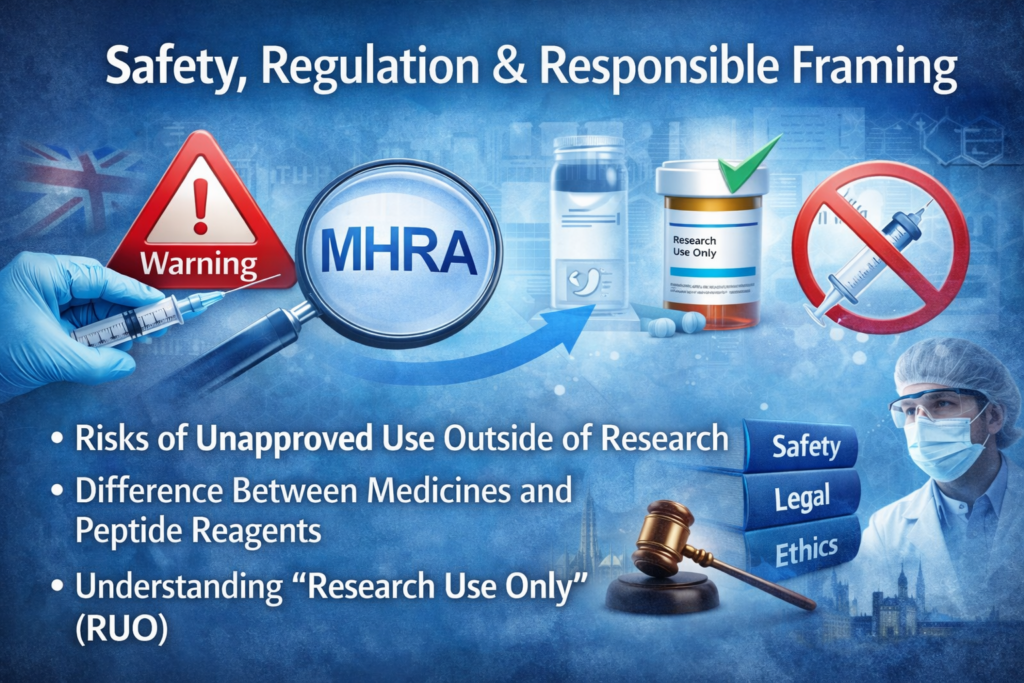
When writing about peptide injections, this section is critical for keeping the blog accurate, ethical, and compliant—especially for a UK audience. It helps readers understand why peptide injections belong in regulated research and medical settings, not informal or unsupervised use. Peptide Injections
Regulatory bodies and legal commentators consistently warn about the risks associated with injecting unlicensed or unapproved peptides outside of formal research or medical frameworks. Key concerns include:
This is why reputable scientific and regulatory sources strongly discourage self-injection of peptides obtained outside licensed medical pathways.
It’s also important to distinguish between:
Blurring this distinction can mislead readers and create legal and ethical problems, so your blog should reinforce it clearly. Peptide Injections
“Research Use Only” (RUO) labelling indicates that a peptide:
This framework protects both suppliers and researchers while supporting legitimate scientific work. Peptide Injections
In the UK, selling or promoting peptides for human injection without appropriate authorisation can fall foul of medicines legislation and trading standards. Ethical research practice therefore requires:
Suppliers such as LabGradePeptides.uk align with this approach by providing high-purity peptide materials strictly for R&D, while explicitly not promoting them for self-injection or medical treatment.
Your calls-to-action should always be phrased in a way that reinforces compliance, for example:
This ensures your blog educates readers, supports SEO goals, and remains firmly on the right side of UK regulatory expectations. Peptide Injections
Peptide injections play a vital role in modern biomedical and pharmaceutical research, not because they are a lifestyle trend, but because they offer a reliable and controlled way to study peptide biology. From endocrine signalling and metabolic regulation to immunology and drug development, injectable delivery allows researchers to overcome the inherent limitations of oral peptide administration and generate reproducible, interpretable data.
Throughout this article, the key distinction has been between legitimate research use and unregulated personal use. While some peptide-based medicines are licensed and prescribed under medical supervision, many peptides discussed online are unapproved research compounds. These belong strictly in laboratories, handled by trained professionals and used only within ethical and regulatory frameworks. Peptide Injections
For UK-based laboratories, universities, and formulation scientists, sourcing high-quality peptide material is the first step in this process. Suppliers such as LabGradePeptides.uk occupy this upstream role by providing high-purity, research-grade peptides intended solely as reagents. Any formulation into injectable solutions, dosing decisions, or experimental administration occurs downstream—under institutional approval and regulatory oversight—not at the point of sale.
By framing peptide injections in this way, your blog can educate readers accurately, support responsible research practices, and clearly communicate compliance with UK expectations. Peptide injections are best viewed not as consumer products, but as tools of science—powerful when used correctly, and inappropriate when taken out of context. Peptide Injections
Peptide injections refer to injectable solutions containing peptide molecules, used primarily in scientific research and regulated medicine to study hormones, metabolism, immune responses, and tissue repair.
Most peptides are poorly absorbed when taken orally and are rapidly broken down by digestive enzymes. Injection-based delivery bypasses digestion and allows more predictable exposure in research settings. Peptide Injections
Yes. Peptide injections are widely used in drug development, preclinical studies, and clinical trials to evaluate pharmacokinetics, pharmacodynamics, and biological activity.
Safety depends on context. Licensed peptide medicines are used under medical supervision, while research peptides are not approved for human use and should only be handled by trained professionals in controlled research environments. Peptide Injections
In the UK, peptide injections are legal only when part of approved medical treatment or regulated research. Selling or promoting research peptides for self-injection is not permitted.
“Research use only” means the peptide is supplied strictly as a laboratory reagent, not as a medicine, therapy, or injectable product for humans or animals. Peptide Injections
No. Research peptides are not approved for human injection and should not be self-administered. Any injectable use occurs only within approved research or clinical-trial frameworks.
Common categories include metabolic peptides (e.g. insulin analogues, incretins), growth hormone–related peptides, immunological peptides, and peptide-based vaccines—all studied under controlled conditions. Peptide Injections
Laboratories source high-purity, lyophilised peptide materials from specialist suppliers and then formulate them internally under sterile, regulated conditions for approved experiments.
UK laboratories can source research-grade peptide reagents from LabGradePeptides.uk, which supplies peptides strictly for R&D purposes only, not for self-injection or therapy. Peptide Injections