

Peptides for muscle growth are short chains of amino acids that have become an important focus in muscle development and recovery research. Rather than acting as full hormones themselves, these compounds are studied for how they modulate anabolic signaling pathways, particularly those involving growth hormone (GH) and insulin-like growth factor-1 (IGF-1)—two central regulators of muscle protein synthesis and tissue adaptation. peptides for muscle growth
In laboratory and preclinical research models, peptides are investigated for their ability to influence:
This makes peptides highly relevant in exercise physiology, endocrinology, and tissue repair research, where scientists aim to better understand how muscle adapts to training stimuli at a molecular level.
Importantly, peptides discussed in muscle growth research are experimental compounds. While some have been examined in human clinical studies under controlled conditions, many remain unapproved for therapeutic use and are not licensed medicines. In the UK, these compounds may be legally purchased only when supplied strictly for Research & Development (R&D) purposes, with clear labeling that they are not for human consumption.
For UK-based laboratories, sourcing peptides responsibly is essential. LabGradePeptides.uk supports this research area by supplying research-grade peptides intended for laboratory, in-vitro, and educational use only. By focusing on compliance, purity, and UK-based delivery, such suppliers enable researchers to explore muscle growth mechanisms while remaining aligned with regulatory and ethical expectations. peptides for muscle growth
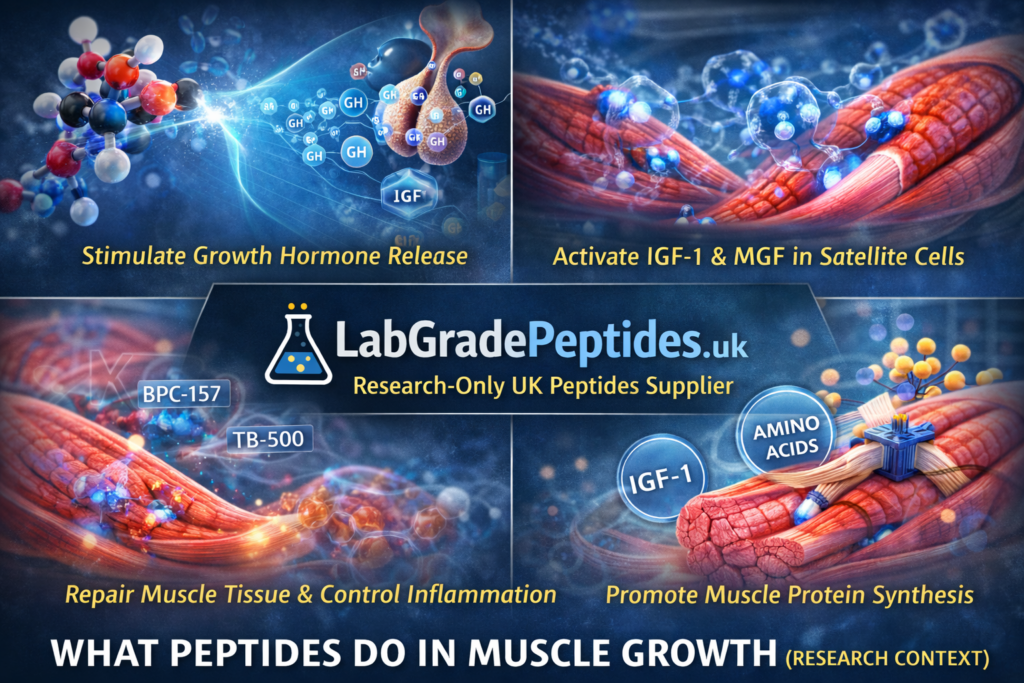
In muscle growth research, peptides are studied for how they modulate anabolic and recovery-related signaling pathways, rather than functioning as direct muscle-building agents. Their role is primarily regulatory, influencing how the body responds to mechanical stress, exercise stimuli, and tissue damage in experimental models.
Many peptides investigated in muscle research act upstream of key anabolic hormones. By stimulating or influencing growth hormone (GH) release, they indirectly increase circulating insulin-like growth factor-1 (IGF-1), which plays a central role in:
These pathways are fundamental to how skeletal muscle adapts in both animal and clinical research settings. peptides for muscle growth
Peptides are often examined in laboratory models for their effects on:
Some experimental studies also explore hyperplasia, though evidence for new fiber formation remains limited and highly model-dependent.
IGF-1 variants, such as mechano growth factor (MGF), are of particular interest due to their role in:
This area of research is especially relevant to understanding recovery after resistance training or injury. peptides for muscle growth
Beyond growth signaling, certain peptides are studied for their influence on:
By shortening recovery time between experimental training stimuli, these mechanisms indirectly support greater training volume and adaptation in research models.
Overall, peptide research in muscle growth focuses on mechanistic insight—helping scientists understand how muscle tissue responds to anabolic signals and repair processes—rather than promoting direct performance enhancement.
Muscle growth research examines several distinct peptide categories, each targeting different biological mechanisms involved in hypertrophy, regeneration, and recovery. These compounds are investigated in controlled laboratory and preclinical models and remain experimental unless otherwise approved for clinical use. peptides for muscle growth
This category focuses on peptides that stimulate endogenous growth hormone (GH) release rather than supplying GH directly.
Research interest centers on observed increases in lean body mass, muscle cross-sectional area, and recovery markers in certain populations, while emphasizing that long-term safety and optimal protocols require further study.
IGF-1 signaling is central to muscle adaptation, making this group highly relevant to muscle biology research. peptides for muscle growth
These peptides are considered highly experimental and are often tightly regulated, limiting their availability outside laboratory research contexts.
Rather than directly increasing anabolic hormones, these peptides support repair and regeneration, which indirectly influences muscle development. peptides for muscle growth
By enhancing recovery capacity in experimental models, these peptides may allow for greater training stimulus tolerance in research settings.
Short bioactive peptides derived from dietary proteins have also gained research attention.
This category bridges nutrition science and peptide biology, offering insight into non-hormonal muscle growth mechanisms. peptides for muscle growth
Across all categories, it is essential to emphasise that these compounds are studied as research tools, not approved muscle-building agents. Responsible discussion frames them within experimental biology, avoiding claims of guaranteed outcomes or human performance enhancement.

Interest in peptides for muscle growth is supported by a growing body of human clinical research, animal studies, and preclinical investigations. Together, these studies help clarify how peptides influence muscle-related pathways while also highlighting current limitations and unanswered questions.
Several controlled trials have examined growth hormone secretagogues (GHS) in human populations, particularly older adults and individuals with reduced anabolic signaling. peptides for muscle growth
These findings suggest biological activity while reinforcing the need for further long-term safety and efficacy research.
Systematic reviews of GH secretagogues and related compounds provide a broader perspective:
Such reviews position peptides as biologically active but not universally effective across all muscle-related endpoints. peptides for muscle growth
Animal models and in-vitro research offer deeper mechanistic insight into peptide-driven muscle adaptation.
These studies are particularly valuable for understanding cellular pathways and interactions that cannot be easily isolated in human trials. peptides for muscle growth
Despite encouraging findings, several gaps remain:
For this reason, peptides for muscle growth should be framed as an emerging research area, where ongoing laboratory and clinical work continues to refine understanding.
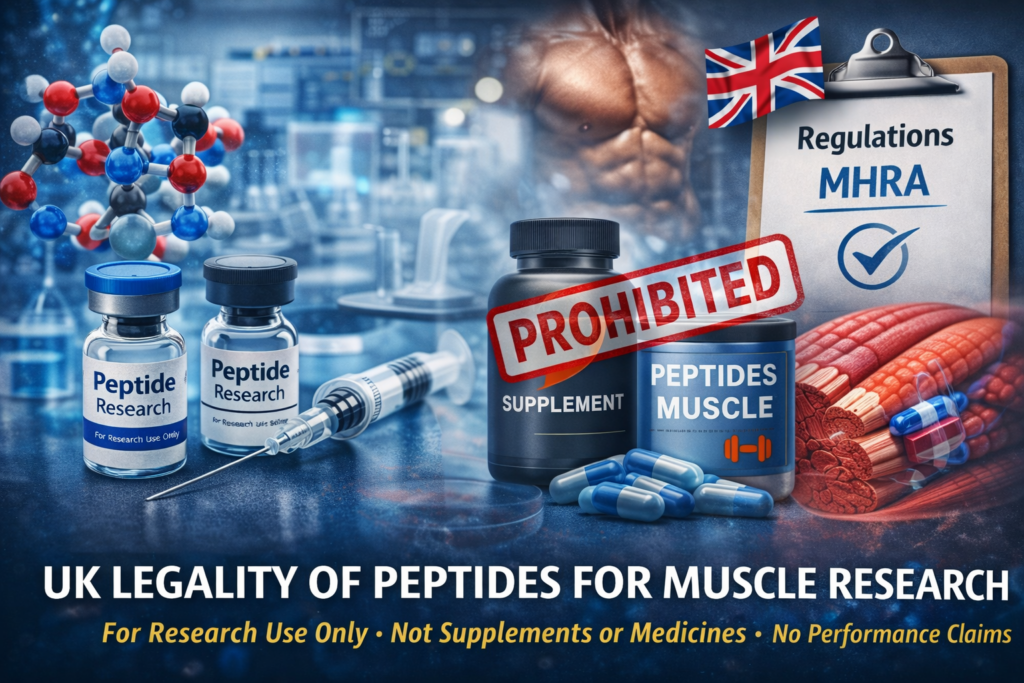
For a UK audience, understanding the legal and regulatory framework around peptides is essential—especially when discussing muscle growth research. The legality of peptides in the UK depends largely on how they are marketed, labeled, and used, rather than on the molecules themselves. peptides for muscle growth
In the UK, most peptides used in laboratory settings are not classified as controlled substances. They can be legally bought and sold when supplied strictly for research purposes only. This includes use in:
Crucially, legality applies only when peptides are not marketed or sold for human or veterinary consumption.
UK medicines regulations prohibit:
Any peptide promoted for human use without proper authorisation would fall under medicines law and be illegal to sell. peptides for muscle growth
The Medicines and Healthcare products Regulatory Agency (MHRA) oversees substances marketed as medicines in the UK. Peptides remain outside this scope only when clearly positioned as research chemicals. Proper compliance therefore requires:
Sourcing peptides domestically helps researchers stay compliant by:
Suppliers such as LabGradePeptides.uk operate within this framework by supplying research-grade peptides exclusively for non-human, laboratory use, helping UK labs access materials legally and responsibly.

When conducting muscle growth research in the UK, sourcing peptides from a compliance-focused, research-only supplier is essential. This helps protect both the integrity of the research and the legal standing of the laboratory. peptides for muscle growth
LabGradePeptides.uk supplies peptides exclusively for Research & Development (R&D). Products are clearly labeled “For Research Use Only”, with no marketing for human consumption, bodybuilding, or performance enhancement—aligning with MHRA and Trading Standards expectations.
For reproducible muscle research, compound integrity matters. LabGradePeptides.uk emphasizes:
These practices reduce variability and support reliable experimental outcomes. peptides for muscle growth
Domestic sourcing offers practical advantages for laboratories:
This reliability is especially valuable for time-sensitive studies or long-running research programs.
The supplier’s catalog reflects actual research demand—including peptides studied in anabolic signaling, recovery, and tissue repair—without consumer-oriented claims. This research-centric approach makes procurement straightforward for universities, private labs, and qualified professionals. peptides for muscle growth
Ethical responsibility is a core requirement when researching peptides related to muscle growth. Because these compounds are often discussed outside scientific contexts, it is especially important for laboratories and researchers to maintain clear boundaries between experimental research and human performance use.
Peptides sourced for muscle growth studies must be treated strictly as Research Use Only (RUO) materials. This means:
RUO compliance ensures peptides remain within legal and ethical limits under UK regulations. peptides for muscle growth
While suppliers are responsible for correct labeling and marketing, researchers also have clear obligations:
These practices protect scientific credibility and prevent misuse of research findings.
Muscle-related peptide research can easily be misinterpreted by non-scientific audiences. Responsible communication should:
This distinction is critical for maintaining public trust and regulatory compliance peptides for muscle growth.
Ethical sourcing supports ethical research. Platforms such as LabGradePeptides.uk reinforce responsible use by:
Together, responsible researchers and compliance-first suppliers help ensure that peptide research into muscle growth advances science without crossing ethical or legal boundaries.
Peptides have become an important area of investigation in muscle growth and recovery research, offering scientists valuable tools for studying how anabolic signaling, tissue repair, and adaptation mechanisms function at a molecular level. By influencing pathways involving growth hormone, IGF-1, satellite cell activation, and inflammation control, peptides help researchers better understand how muscle tissue responds to training stimuli and injury in controlled experimental settings. peptides for muscle growth
At the same time, it is critical to recognise that many peptides discussed in muscle research remain experimental compounds. While supported by a mix of human clinical data and extensive animal research, they are not approved medicines and are not authorised for human performance enhancement. Their legitimate role lies firmly within laboratory, in-vitro, and preclinical research.
For UK laboratories, responsible progress in this field depends on ethical practice, regulatory awareness, and compliant sourcing. Purchasing peptides strictly for research purposes, ensuring proper documentation, and avoiding consumer-focused claims protects both scientific integrity and legal standing. peptides for muscle growth
By supplying research-grade peptides exclusively for R&D use, LabGradePeptides.uk provides UK researchers with a dependable pathway to explore muscle growth mechanisms while remaining aligned with MHRA and Trading Standards expectations. Used responsibly, peptides can continue to contribute meaningfully to our understanding of muscle biology—advancing science without crossing ethical or legal boundaries.
Here are 10 human-optimised, SEO-friendly FAQs for your Peptides for Muscle Growth research blog.
They’re written clearly, naturally, and stay fully UK-compliant (research-only)—ideal for RankMath FAQ schema and People Also Ask results. peptides for muscle growth
Peptides for muscle growth are short chains of amino acids studied in research for how they influence anabolic pathways such as growth hormone (GH) and IGF-1, muscle protein synthesis, and recovery mechanisms in experimental models.
No. In research settings, peptides do not act like anabolic steroids. Instead, they modulate biological signaling pathways that influence how muscle tissue adapts, repairs, and grows in response to stress or training stimuli. peptides for muscle growth
Research commonly focuses on:
All are studied strictly in laboratory or preclinical models.
Yes, peptides are legal to buy and sell in the UK when supplied strictly for research purposes only and clearly labeled “not for human consumption.” Selling or promoting them for bodybuilding or performance use is not permitted. peptides for muscle growth
“For Research Use Only” (RUO) means the peptide is intended solely for laboratory, in-vitro, ex-vivo, or preclinical research and is not approved for human or veterinary use.
IGF-1 is central to muscle biology research because it regulates muscle cell proliferation, differentiation, and hypertrophy. Variants like MGF are studied for their role in muscle repair after mechanical stress. peptides for muscle growth
Healing peptides are not studied for direct muscle growth. Instead, they are researched for tissue repair, inflammation reduction, and recovery, which may indirectly support muscle adaptation in experimental models.
Evidence comes from a mix of:
Results vary by compound, model, and protocol, and research is ongoing. peptides for muscle growth
UK-based suppliers reduce customs risks, delivery delays, and regulatory uncertainty, and are more aligned with MHRA and Trading Standards expectations for research chemicals.
UK researchers can source research-grade peptides from suppliers such as LabGradePeptides.uk, which focuses exclusively on R&D-only peptides with clear labeling, documentation, and secure UK delivery. peptides for muscle growth